
Every consultancy I’ve been talking to lately is having the same conversation with clients. It used to open with “we’re evaluating a new CRM” or “we’re finally doing the ServiceNow rollout.” Now it opens with hesitation. Procurement teams that used to sign three-year platform deals without blinking are asking a different question: do we need the whole thing, or just the piece that actually solves our problem?
That hesitation shows up in the numbers, too. ServiceNow’s stock dropped 36% in the first half of 2026. Salesforce is down around 35% over the same period, and KeyBanc downgraded it in July, pointing to Agentforce adoption running behind schedule and more CIOs planning to cut Salesforce budget than expand it. Meanwhile capital keeps flowing into the companies building the chips and infrastructure underneath AI agents. Money is voting, and it’s voting against paying fifty million dollars for a platform when an agent can handle the same workflow for a fraction of the cost.
I’ve seen this exact pattern with several companies I’ve advised, and it’s worth naming plainly, even without pointing at one client: a mid-market firm signs the flagship suite because it’s the safe, board-approved choice. Eighteen months in, they’re using a quarter of what they’re paying for. The rest is unused seats, unused modules, and a support contract nobody remembers negotiating. Ask why they bought the whole platform instead of the one piece they needed, and the answer is almost always the same. There was no credible alternative at the time. Building something custom meant hiring a dev team and hoping it didn’t break. So they bought the factory to get one machine.
That’s not a new mistake. It’s a hundred years old, and the company that made it first, at a scale nobody’s matched since, was Ford.
The Rouge
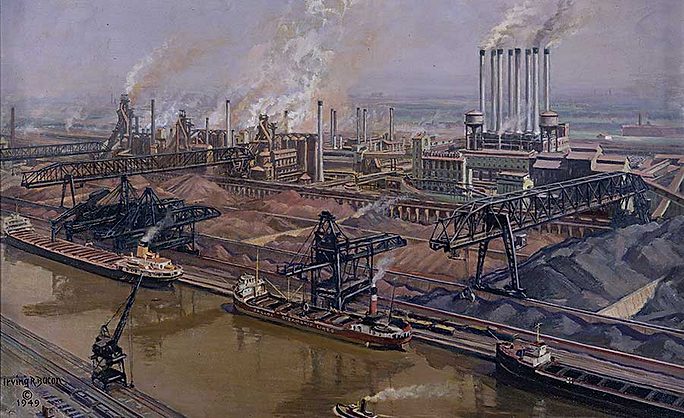
In 1917, Henry Ford started buying land along the River Rouge in Dearborn. What he built there over the next decade wasn’t a factory. It was an attempt to own the entire physical chain of building a car, from raw ore to the finished vehicle, within a single, continuous complex. Iron came in on Ford’s own lake freighters, hit Ford’s own blast furnaces, became engine blocks in Ford’s own foundry, and rolled out the other end as a Model A. Ford owned coal mines in Kentucky, iron mines in Minnesota, a rubber plantation in Brazil, and a hundred miles of interior railroad just to shuttle materials between buildings. At its peak, the Rouge employed over 100,000 people at a single site.
It worked, in the way owning everything can work when you’re the only one doing it at that scale. It also produced some of Ford’s worst decisions. Fordlandia is the clean example. Ford sank twenty million dollars into a Brazilian rubber plantation, tried to run it on a Dearborn factory schedule, ignored decades of local agricultural knowledge, and planted rubber trees in dense rows that let a leaf fungus wipe out the crop inside a year. By 1945 he sold the whole operation back to the Brazilian government for two hundred fifty thousand dollars. He owned the rubber supply chain. He just wasn’t any good at running it, because rubber farming has nothing to do with what made Ford good at building cars.
That’s the real lesson, and it usually gets told wrong. People remember “vertical integration was efficient, then it got bloated.” The more accurate version: owning the whole stack forces you to be excellent at things that have nothing to do with your actual edge. Ford was extraordinary at assembly-line engineering. He was mediocre at mining and genuinely bad at agriculture. The bigger the Rouge got, the more of his attention went to problems that weren’t the problem he’d built the company to solve.

By the 1980s the auto industry had worked this out. Manufacturers stopped trying to own every input and started orchestrating a network of specialists instead. Nobody at Ford or GM invents a braking system from scratch anymore. They integrate Brembo, because Brembo has spent decades doing nothing but brakes and does it better than a car company ever could as a side project. The monolith didn’t get destroyed. It got unbundled into a supply chain of people who are excellent at one specific thing, coordinated by someone who’s excellent at putting the pieces together.
The Pivot
Enterprise software is having that exact moment, a century later. For a decade, the safe move for any company scaling past ten million in revenue was to buy into a Salesforce or a ServiceNow. One platform, one vendor, one very long contract, and every workflow you might ever need is theoretically in there somewhere. That’s the Rouge strategy. Buy the whole factory to get one part running.
The economics of that only made sense when the alternative was building custom software from scratch: a dev team, an infrastructure budget, a multi-year timeline with no guarantee it works. That alternative is gone. What’s replaced it isn’t “build everything yourself” either. It’s closer to what the auto industry figured out. Modular, specialized components, built for the exact workflow you have, integrated by someone who knows how to make the pieces work together.
Most of the commentary on this shift gets it backwards. The assumption is that once clients can build their own AI tools, they’ll need fewer consultants, the way self-checkout reduced the need for cashiers. The data says the opposite is happening. Natural-language tools have made it trivially easy for someone in finance or marketing to generate a working app with no code. That’s real, and it’s happening inside almost every mid-size company right now.
It’s also produced a governance crisis nobody budgeted for. Business units are spinning up agents with no security review, no documentation, no plan for how they’ll integrate with anything else the company runs. It’s shadow IT, except now any employee can generate it in an afternoon. The fragility doesn’t show up right away. It shows up eighteen months later, when three departments have each built an agent that touches customer data differently, none of it is logged anywhere, and the CISO finds out during an audit.
That’s not a shrinking market for consulting. That’s demand moving to a different altitude. Clients don’t need someone to configure a CRM anymore. They need someone who can walk into a pile of ungoverned, AI-generated tooling and build the governance layer, the security framework, and the integration architecture that turns it into something an enterprise can actually run on. The firms picking up that work aren’t pricing by the hour. They’re pricing by outcome, because the value was never “hours spent.” It was “problem actually solved.”
What this means if you run a consultancy
If you’re advising companies on technology right now, the opportunity isn’t defending the old model. It’s becoming the equivalent of Brembo. The specialist who owns one part of the stack completely, from figuring out which workflows actually deserve an agent, through building it, through the unglamorous work of making sure it doesn’t create a security hole six months later.
A few things follow from that, if you’re repositioning.
- Stop selling platform expertise. Clients don’t need someone certified in a suite anymore. They need someone who can look at a business process and say, honestly, whether it needs a monolith, a niche agent, or nothing at all. That judgment is worth more than the certification ever was.
- Price for the outcome, not the build. The old billable-hour model assumed the hard part was writing code. The hard part now is knowing which fifteen use cases out of two hundred are actually worth automating, and building the governance so the automation doesn’t collapse under its own weight. That’s consulting, not labor arbitrage, and it should be priced accordingly.
- Build the full pipeline, not just the flashy part. Anyone can demo an agent. Far fewer firms can take a client from “we don’t know what our AI opportunities even are” through discovery, build, deployment, and the ongoing governance that keeps it from becoming next year’s audit finding. That end-to-end capability is the actual moat right now, because it’s genuinely hard to build, and most competitors are still stuck on the demo.
Ford never fully let go of the instinct to own everything. Even after selling off the steel operations, the Rouge kept a version of vertical integration well into the 1980s, because giving up control is harder than it sounds when you’ve built your identity around owning the whole chain. The consultancies that win this decade won’t be the ones clinging to platform certifications, nor will they be the ones trying to build everything in-house. They’ll be the ones who figure out, faster than everyone else, exactly which part of the stack is worth owning completely, and which part is better left to somebody who does it better.