
 | How strongly I recommend it: 10/10 Read more details & reviews (Amazon) |
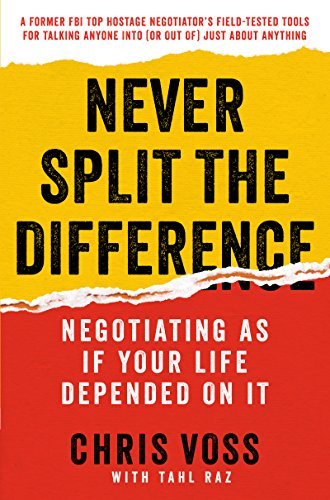
There hasn’t been one book where I found more valuable lessons on negotiation than in Chris Voss’s “Never Split the difference”.
Having experienced a tough professional life as an FBI hostage negotiator Chris advocates a whole different and counterintuitive negotiation philosophy that I only can recommend studying. You might become as surprised as I was when I first imagined hostage negotiation as a brutal powerplay trying to use force as the only lever. But Chris explains that this is the total opposite of a successful bargaining strategy (he calls it “old-school”).
In my university classes, we’ve learned negotiation as a game of two rational decision-makers each trying to get the best outcome based on pure logic. We’ve learned terms like “BATNA” or “ZOPA”.
But in reality, negotiation is dealing with real people and people have emotions that influence their decisions.
As a very experienced high-stakes negotiator, Voss advocates a deep understanding of the other person in negotiation and favors the term “negotiation partner” over “opponent”. For him, a “negotiation is not a wrestling match” but rather a common journey:
“A negotiation is not an act of battle; It’s a process of discovery. The goal is to uncover as much information as possible. ”
The book contains many examples and tales from real negotiations that help the reader to digest the content. In the following, I want to briefly cover the core concepts:
Tactical Empathy
Tactical Empathy can be described as the core concept of this book. Chris Voss stresses that in most situations emotions are the main driver of our behavior. By recognizing, acknowledging, and responding to emotions both sides can find a better outcome for both parties.
Empathy is paying attention to another human being, revealing what they are feeling, and making a commitment to understanding their world.
Contrary to the mainstream belief that empathy is a soft trait that you either have or don’t have you can train yourself to be more empathetic. Also, there are tools (described in the book) that help negotiators to use empathy as a successful tactic.
“Empathy helps us learn the position the enemy is in, why their actions make sense (to them), and what might move them.”
Emotional Openness / Building and verifying Hypotheses / Question Assumptions
The most important concept in any good negotiation is to start with a clear mind which is not preoccupied with your own arguments waiting for leaving your mouth.
Stay open and build hypotheses about the needs and wants of your counterpart. Try to verify or falsify those hypotheses and always question most of your own assumptions about anything.
Remain more emotionally open to all possibilities, and more intellectually agile to a fluid situation.
“Good negotiators, going in, know they have to be ready for possible surprises; great negotiators aim to use their skills to reveal the surprises they are certain to exist.”
Create a safe atmosphere so that your counterpart keeps talking openly.
Slow it down. Don’t be too much in a hurry as the risks undermine the trust you’ve built.
The Voice
Radiate warmth and acceptance and conversations just seem to flow
3 voice tones:
1. late-night FM DJ voice – the voice of calm and reason, signaling “I’m in control”, leaves no room, to be used when an item isn’t up for discussion.
2. positive/playful voice (most of the time) -> easygoing, good-natured person. attitude-> light & encouraging, relax & smile while talking, smiling will increase your own mental agility.
3. direct/assertive voice -> Not recommended. Signaling dominance that creates resistance.
Mirror
The general idea here is to extract as much information as possible.
You want to remove psychological hurdles between you and the other person so that information can flow freely. In general, we fear what’s different and are drawn to what is similar.
Similarity sometimes can be achieved by copying each other’s mimics and gestures or claiming to have things in common. But those “slimy sales tactics” can backfire and create the opposite effect.
This is why for the FBI negotiators a “mirror” is just the repetition of the last three words from what you’ve just heard. It’s not another question (e.g. “What do you mean by that?”) as this could irritate the other person.
The intention is: “Please, help me understand.” This gets you clarity while you signal respect and concern for what the other person is saying.
The other person is forced to re-think and explain her idea again but in a different way with (more) information revealed (ideally their strategy).
Labeling
“Think of labeling as a shortcut to intimacy, a time-saving emotional hack.[…]Labeling is a simple, versatile skill that lets you reinforce a good aspect of the negotiation, or diffuse a negative one.”
The scientific background for labeling an emotion is that it moves brain activity to areas with rational thinking. So labeling is a must-have tool for tactical empathy aiming for moving a conversation to a more collaborative and trusting exchange. It means the articulation of the feelings of your counterpart. You recognize what a person might feel in a given situation and then you translate the perceived feeling into a sentence that invites the other person to open up and reveal their own emotions.
It’s very important to describe your own perception from the perspective of you as a neutral observer of their behavior. It should not sound like you know exactly what the other person feels because your conclusion could still be a misinterpretation.
The sentence should always start with “It seems like…” or “it looks like”.
NOT: “You are afraid.”
BETTER: “It seems like you are afraid.”
After a label, you should stay silent and wait for a response (even if this takes a while) and then only focus on LISTENING.
After you’ve correctly labeled a negative feeling (and got it confirmed by the other person) you can introduce positive, compassionate and solution-based thoughts.
The value of “No”
You give your counterparts the feeling of being in control when they have a chance to answer a question with “No”. This leads to more security and safety which again builds trust and free flow of information.
A “No” is a reaffirmation of autonomy and also helps you to reveal the real needs and wants.
Be aware of the counterfeit “Yes” as this is often a way out, just to “give the salesperson what she wants so that she leaves me alone and in peace”.
Paraphrase
After a while, repeat what your counterpart is saying in your own words. This shows real understanding to the other person but also helps yourself to remember key points better.
Summaries & “That’s right”
Summary = paraphrasing + labeling
A good summary mentions all the points that your counterpart raised (paraphrases) and combines them each with labels of the underlying emotions.
After a good and complete summary, you want your counterpart to say “That’s right”, as a confirmation of real understanding. This creates a positive, common ground:
“When your adversaries say, “That’s right,” they feel they have assessed what you’ve said and pronounced it as correct of their own free will. They embrace it.”
Voss stresses that “That’s right” is very different from a “Yes” as a “yes doesn’t mean anything without a “how”. As a negotiator, you need to make sure that there is a common and real understanding of all the aspects of an agreement. This includes the operational aspects.
And “That’s right.” is even more different from a “You’re right.” People often say “you’re right.” when they want to be left alone but this doesn’t mean that they agree to your position.
You need to convince someone that you truly understand her whole world if you want to change the behavior and thoughts of a person for achieving a real breakthrough:
“The more a person feels understood, and positively affirmed in that understanding, the more likely that urge for constructive behavior will take hold.”
Accusation Audit
The goal of an accusation audit is to reveal all negative things that the other party is thinking and/or saying about you. It’s a preemptive measure that can be used in crisis situations but also as a starting point of any negotiation. By an accusation audit, you show empathy and your partner often feels valued. Also, by giving negative emotions a label and putting them out in the open they become less distractive when finding constructive solutions.
Things to do:
- List every negative thing your counterpart could say about you.
- Ask yourself: What are the biggest possible accusations?
- Label their potential emotions and confront them with that label as part of your conversation. Label their fears and ask for input. This creates a constructive atmosphere and can help to find common ground. You can say sentences like “You may feel like we’ve treated you unfairly…”, “We acknowledge that your believe that we did XYZ wrong..”, etc…
- Try to reveal even more negatives by asking questions like: “What else is there you feel is important to add to this?”
Bargaining
Compromising:
When it comes to bargaining, the most contrarian position of Chris Voss is his attitude towards the typical win-win mindset, which is also the title of the book: Never split the difference!
He says that compromising is usually ineffective and often disastrous: “At best, it satisfies neither side. And if you employ it with a counterpart who has a win-lose approach, you’re setting yourself up to be swindled.”
Deadlines:
In most cases, deadlines are an artificial construct to rush the negotiation process. Under the pressure of a deadline people do impulsive things that are against their best interests.
Fairness:
“Fair” is an emotional term people use when they want to gain concessions. Stay alert when you hear the “f-word” and when you hear it ask your counterpart to explain how you’re mistreating him/her. It’s also wise to demand full proof for why something is considered to be fair.
A crucial aspect in any negotiation: Find out how your counterpart arrived at their position.
Anchoring:
Set an extreme anchor to make your “real” offer seem reasonable. You can also create a range (where the lower end is your actual offer).
Fear of loss:
People fear loss more than they value any gain. So they take more risks to prevent loss. Make sure that inaction will lead to some form of loss.
Illusion of Control & Calibrated questions
“The secret of gaining the upper hand in a negotiation is giving the other side the illusion of control.“
Negotiations usually start with two parties resisting each other’s words. Each side tries to impose each other’s view because of a general “unbelief”. The secret now is not to make the other party believe what you say but just to stop the unbelief.
The main tool for stopping the unbelief is “calibrated questions”. They are open-ended and mostly start with “how” or “what” (E.g. “how am I supposed to do that?”).
In essence, you ask for help. Such questions force the other side to think about how to solve the (your) problem.
“The implication of any well-designed calibrated question is that you want what the other guy wants but you need his intelligence to overcome the problem.”
So the whole idea of calibrated questions is to lead your counterpart to a solution that is in your favor while they stay in full control of the situation. There is no force and no pushing but an activation of the rational mind of the opponent.
Calibrated questions offer no target for an attack like statements do. The rather educate about the problem without causing conflict.
How to design calibrated questions:
It’s best to start with “how” and “what” and sometimes “why” (only when you want to use the defensiveness it creates).
Examples:
- What about this is important to you?
- How can I help to make this better for us?
- How would you like me to proceed?
- What is it that brought us into this situation?
- How can we solve this problem?
- What’s the objective? / What are we trying to accomplish here?
- How am I supposed to do that?
Process:
1. Don’t confront them on their ideas
2. Acknowledge their ideas openly, admit your understanding
3. Guide them toward solving the problem by asking calibrated questions
The patient, self-controlled listener has control! Avoid emotional reactions.
Execution of the agreement
“Yes is nothing without How.”
A deal is only worth as much as its execution. A good negotiator ensures that the operational part of an agreement takes place without any major surprises and does their best to ensure great execution.
The tool of choice can also be here a calibrated question, e.g.: “How will we know we’re on track?” or “How will we address things if we find we’re off track?”
Their respective answers can then be summarized and brought to a “That’s right.”
Also, be aware of the teams behind the table. The execution can be severely limited by the people who actually must do the work and NOT sitting at the bargaining table. Can they assert their power later on? Consider their interests early enough! E.g. by asking “How does this affect the rest of your team?”
7-38-55 Rule
According to UCLA Professor Albert Mehrabian studies, only 7% of a message is based on the words while 38 percent comes from the tone of voice and 55 percent comes from the body language and facial expression.
-> Pay close attention to body signals and the tone of voice
-> Make use of personal meetings (if possible)
-> Become aware of your own body signals and tone of voice and use it consciously
Black Swans
When all the tools will be orchestrated together by the experienced negotiator (which is an art form by itself) it is possible to uncover hidden & unexpected information. This is what Voss calls a “Black Swan” (a slightly different meaning than Nassim Taleb’s definition).
The new information can then change the outcome of a negotiation completely.